


Sanctuary in a Jazz Club

Jazz was my sanctuary that night in Chicago. Michelle and I had slipped into the Jazz Showcase, where saxophonist Bobby Watson, the Reggie Thomas Trio, and the luminous vocalist Mardra Thomas transformed the dimly lit club into something sacred. The music—aching, alive, arresting—moved through us like prayer.

Midway through the set, they welcomed a group of younger musicians to the stage, including a breathtaking pianist named Julian Davis Reid, who introduced himself as a “jazz theologian.” That phrase alone was enough to make my rabbinic soul lean in. After the set, I found him, introduced myself, and we fell into one of those spontaneous, spirit-soaked conversations that only happen when two people of faith recognize each other across tradition. We spoke of music as midrash, of improvisation as revelation, of how jazz helps us testify to the presence of the Divine in a broken world.
A Whisper in the Wilderness
It reminded me of this week’s Torah portion, Vayikra. The book begins not with grandeur or fireworks, but with a gentle gesture: “Vayikra el Moshe”—“The Eternal One called to Moses.” Not commanded. Not shouted. Called. A whisper across the chaos (tohu). A beckoning presence in the pause.
Leviticus is often seen as precise, priestly, procedural. But here at the beginning, it reminds us that sacred structure begins with sacred attention. With listening. With answering the quiet call that comes not despite the noise, but through it.
The T-Shirt That Preached Torah
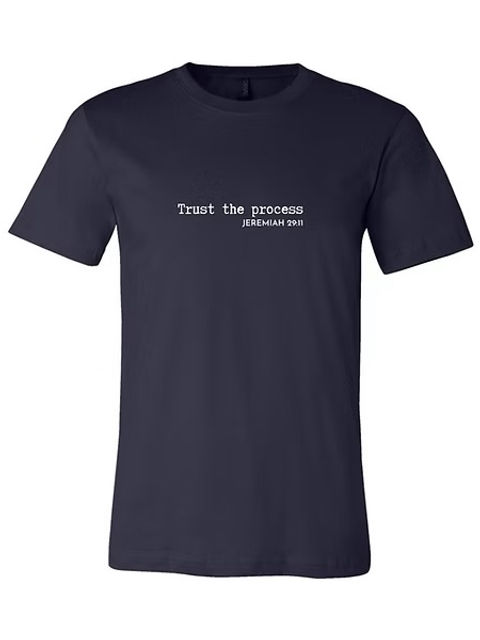
Later in the week, after a full day of learning and leading, I wandered down to Navy Pier to breathe in the blues of Lake Michigan. Inside, I stumbled upon a booth selling clothes stitched with blessing—hats and shirts bearing phrases like “Blessed,” “Be Kind,” and a T-shirt that read “Trust the Process,” quoting Jeremiah 29:11: “For I know the plans I have for you… plans for peace and not disaster, to give you a future and a hope.”
Yes, I bought all three. Sometimes, spiritual messages are meant to be worn as well as heard.
The brand was called CONFIDENCE, created by Robin Harris, a woman of deep Christian faith. She described her mission as empowering people of all shapes and sizes to love themselves and believe in their own greatness. A portion of each sale supports STEEM education and mental health programs especially for young women.
Once again, I found myself in sacred conversation—about faith, about the Holy One, about the holy and humbling task of healing the world through the work of our hands and the words on our sleeves.
Rabbis, Reflection, and the Real Work
In between these two experiences, I sat with 450 other rabbis and with scholars, sages, and seekers at the Central Conference of American Rabbis convention. We were asking complex questions, inviting Torah to teach us a way to clarity:
How do we lead in times of fear and fragmentation?
How do we hold our people close when our own hearts feel weary?
How do we listen for the sacred in the silences?
From Tohu to Tikvah
Out of those reflections came this poem—From Tohu VaVohu to Tikvah. It’s a spiritual meditation. A kind of prayer offered in the hush between what is and what might still be.
From Tohu VaVohu to Tikvah
By Rabbi Paul Kipnes
In the beginning— before beginnings had breath— there was tohu vavohu, not just chaos, but collapse. Not just void, but the violence of everything coming undone.
And the darkness— it was devastating. Dense, drowning, a weight so complete it unstitched the soul. A darkness where nothing moved, and even memory was too frightened to speak.
And the hovering— yes, God hovered— but in the hovering, hope hadn’t happened. No light. No language. Only the breathless weight of waiting.
We know that place. We’ve sat in its silence. We’ve prayed in the rubble, with mouths full of ash, through nights when the stars would not flash, and mornings that failed to rise— lightless hours beneath heavy skies.
Still, some in the long line of our people have dared— not to dream, but to imagine something other than despair.
One, long ago, let the holy fall, let the center collapse, and asked not for what was, but for what might be made anew. Ben Zakkai saw what could not be saved, and still chose to shape a future from the ashes.
Not of stone, but of story. Not of sacrifice, but of study. Not of certainty, but of courage to begin again without knowing what would come.
This is not hope as sunlight. Not hope as anthem. This is the trembling trace of a path drawn in dust— a whisper that there might be a way forward even when forward is still formless.
So we sit. In the tohu. In the devastation. Not rushing resurrection. Not forcing the light.
But listening— for the breath, for the break, for the moment when imagination dares to rise.
And maybe, just maybe, that too is a kind of Tikvah.
Vayikra teaches us that even when the world is swirling with tohu (chaos)—formlessness, void, collapse—the Source of Life (M’kor HaChayim) still calls. Not always loudly. Not always clearly. But consistently. Persistently. Whispering through the rhythms of our days.
Sometimes in a jazz club. Sometimes in a T-shirt stand. Sometimes in the stillness of a soul seeking the Shechinah (God’s Presence).
Tohu (chaos) is real. And so is Tikvah (hope). And the call is always there. The question is: Are we listening?
May we keep improvising our way toward it. May we keep answering the call.


Comments